Crassulaceae - Genusn Aeonium - Aeonium lindleyi

 
Aeonium lindleyi - Webb& berth.

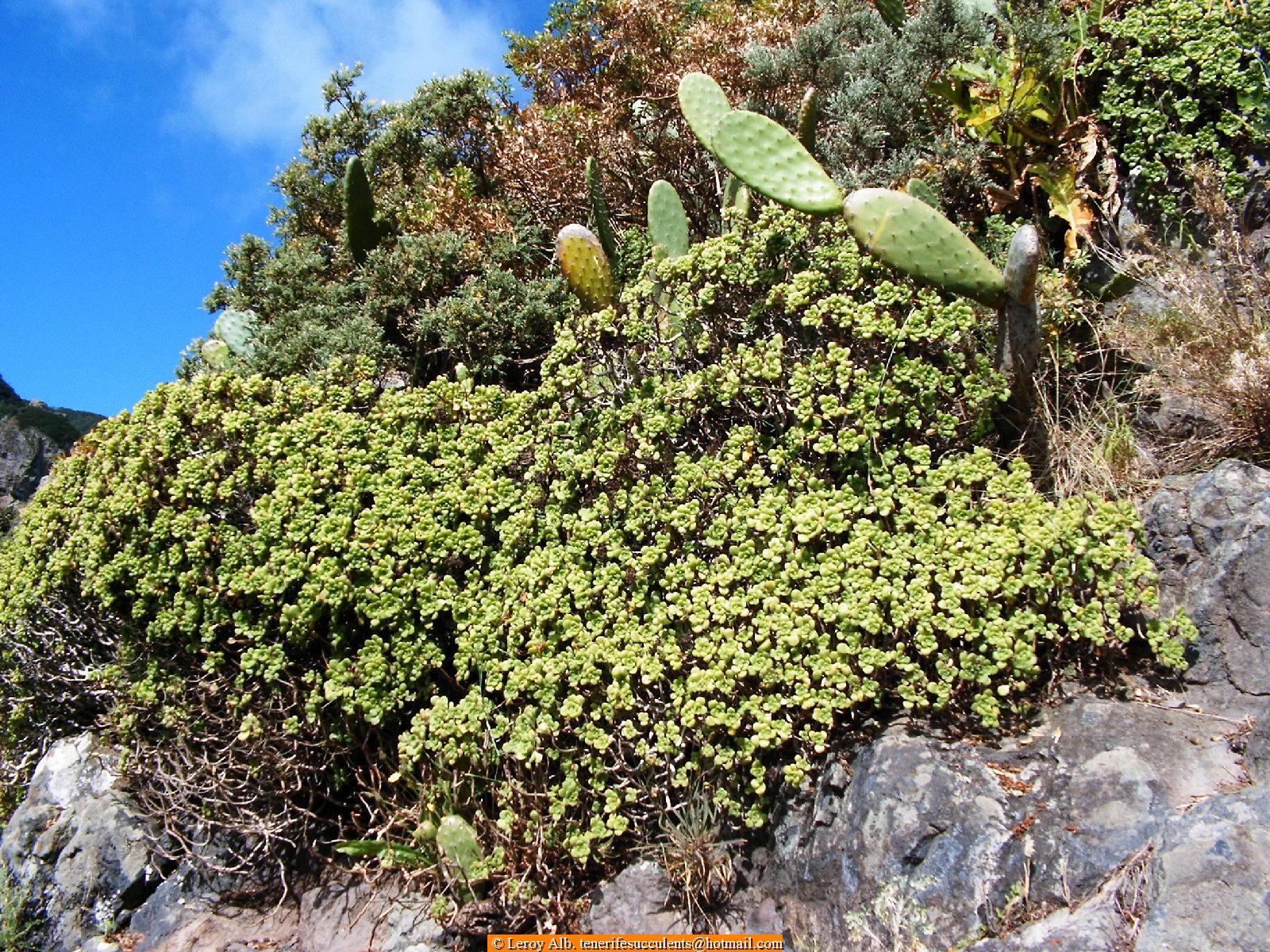
Among the smaller shrubby Aeoniums this species resembles A. viscatum and A. goochiae in having sticky  leaves, but in A. viscatum the leaves are glabrous, not glandular-pubescent, and in A. goochiae the flowers are pink, not yellow. It differs from both in its very fleshy leaves, 6mm or more thick, twice as thick as those of either. The extremely fleshy leaves, indeed, distinguish it from all other Aeonium, in none is the ratio of thickness to breath normally so great.

It is a striking plant on account of its heavy bushes with very  k leaves, but not one of the most attractive.

This sub-shrub is very branched and to 60/70 cm high, very often hanging alongside the cliffs and rocks, has a very special and pronounced smell of balsam. Leaves obovate, pubescent, older leaves green/yellow and the new growth mostly dark green, forming a 5/11cm rosette.

Inflorescence lax, about 5 cm across, flattish, sessile with 10 to 30 flowers.

Flowers 7 to 9 parted, 15mm across , gold-yellow ) flowering May to September

Distribution : endemic to the island of Tenerife and Dr Buchard reported it from La Palma near Tijarafe.  On Tenerife growing as from Taganana to La Orotave ,  San Andres, Igueste de San Andres, Punta Hidalgo, La Laguna, Bajamar, etc....


We could find a hybrid with the Aeonium tabuliforme

This species is used, in case of accident with the latex of Euphorbia, to dilute and neutralise their adhesive and caustic properties, especially with ophthalmic problems.   
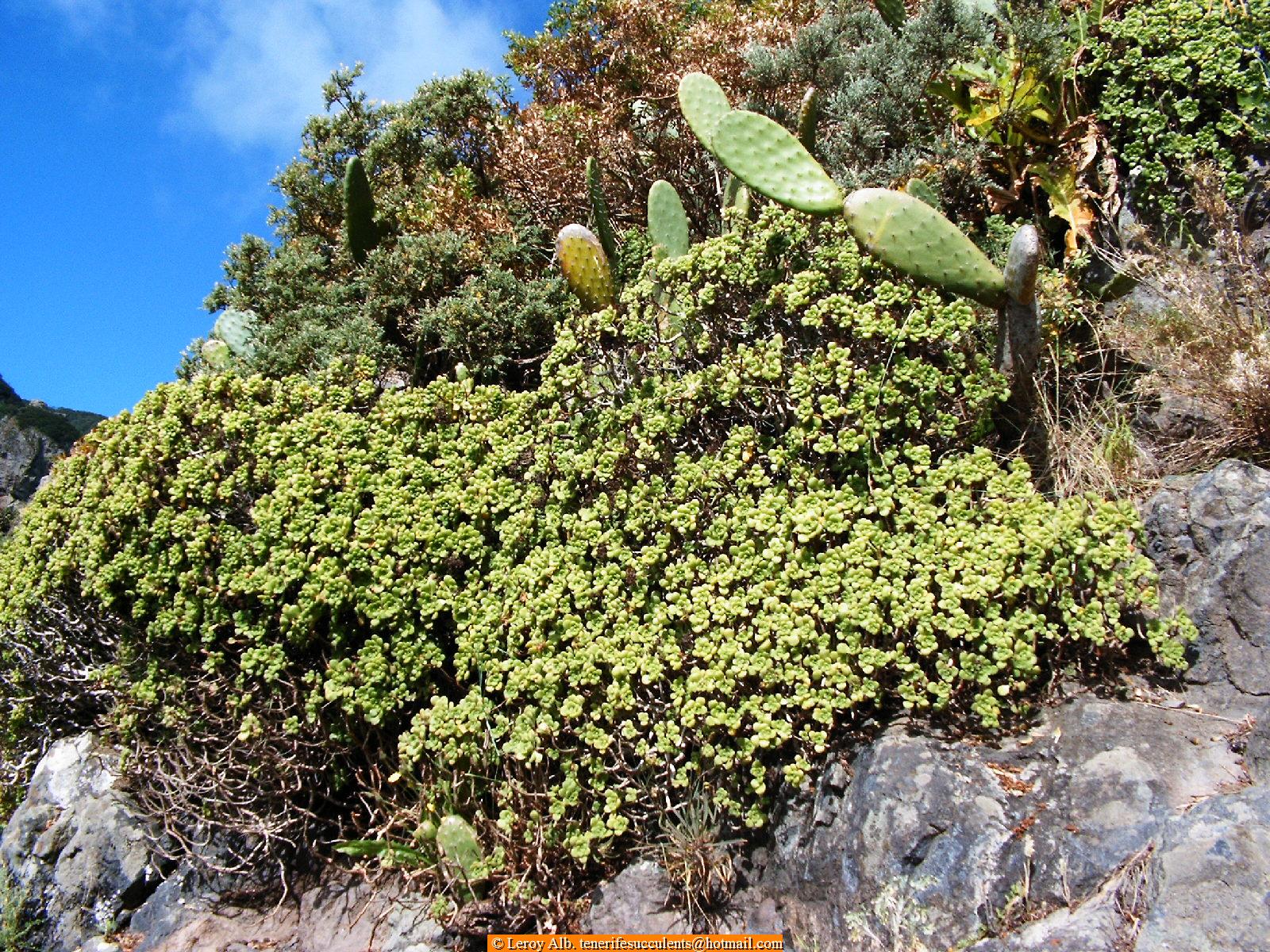


Aeonium lindleyi - Faro de Anaga
 
 
Aeonium lindleyi - Igueste de San Andres
 
Aeonium lindleyi - road top Batan el Alto
 
Aeonium lindleyi
Aeonium lindleyi - Anaga montains
 
Aeonium lindleyi & tabuliforme - Chamorga
 
Hybrid Aeonium tabuliforme X lindleyi - Chamorga
 
 Hybrid Aeonium tabuliforme X lindleyi - Chamorga
 
 
Hybrid Aeonium tabuliforme X lindleyi - Chamorga
in culture


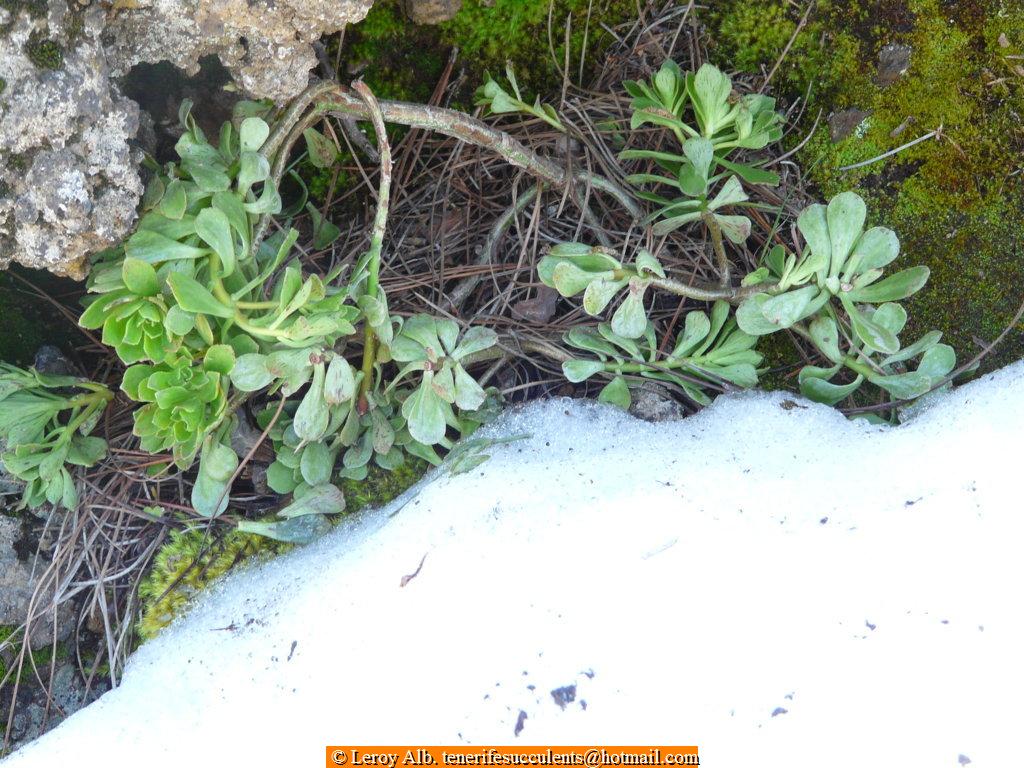
Crassulaceae - Genus Aeonium - Aeonium spathulatum

Aeonium spathulatum (Hornem.) Praeger

Very well distinguished by its bushy growth( 40/60cm high) of rather slender tortuous woody, glossy brown branches, small (1 - 5cm long)obovate-spathulated slightly sticky leaves with longitudinal glands on the back  and translucent swollen bead-like cilia on the edges, and flattish inflorescences of golden flowers on erect often tall leafy stems. The brownish gland-streaked  green leaves it shares only with A. caespitosum and A. smithii.

Young leaves forming a tight, globose bud during the dry season. Flowers 8 to 10 parted.

Plant is endemic from Tenerife, Gran Canaria, La Gomera, LaPalma and El Hierro.

Habitat : grows on cliffs in forest regions and subalpine rocks between 200 and 2250meter high. Locally very common (Santiago del Teide) , Arguayo, Guimar, Las Canadas, La Orotava, etc..           Flowers beginning March until end June.

I often have seen this plant in the Canadas (above 2200meter) into the snow !!! so this plant withstands temps below 0°C ( I could measure -7°C)

View the variability of this species I think we have to consider the var. cruentum as a synonym of the Aeonium spathulatum .


Aeonium spathulatum - Santiago del Teide

Aeonium spathulatum - Santiago del Teide
Aeonium spathulatum - road 821 - 2100meter
Aeonium spathulatum - rosa de piedra - 1900meter
Aeonium spathulatum - Santiago del Teide
Aeonium spathulatum - road 821- vertical wall
Aeonium spathulatum - road 821
Aeonium spathulatum - near Guimar
Aeonium spathulatum - Santiago del Teide
dry season
Aeonium spathulathum - Santiago del Teide
Dry season
Aeonium spathulatum - Santiago del Teide
Dry season
Aeonium spathulatum - road 821 - 2200m snow - minus 7°C

Aeonium spathulatum - road 821 - 2200m snow - minus 7°C
 
Aeonium spathulatum - road 821 - 2200m snow - minus 7°C


Crassulaceae - Genus Aeonium - Aeonium sedifolium

Aeonium sedifolium (Webb) Pit & Proust

Endemic to the islands of Tenerife, La Palma and  La Gomera

Dense, twiggy, erect sub shrub. Densely branching, 45/50cm high with tinny , glossy brown and sticky stem. Small shining sticky fleshy leaves forming small rosettes  1,5/3.5cm diam. much marked with brown/reddish stripes. This small plant produce very few but large yellow flowers, 9 to 11 parted. Flowering from March to end July.

Distribution on Tenerife . I know the plant from the Masca region, Tamaimo, Punta Teno (the path going to Teno Alto), Los Silos, Montana de Taco and Buena Vista del Norte.  

Aeonium sedifolium - site Masca


             Aeonium sedifolium - site Tamaimo

Aeonium sedifolium - Masca - See root système
 
Aeonium sedifolium - Tamaimo - in a rock crack
 
Aeonium sedifolium - Tamaimo
 
 
Aeonium sedifolium - Masca
 
 
Aeonium sedifolium - Tamaimo
 
 
Aeonium sedifolium - Tamaimo
 
 
Aeonium sedifolium with A. urbicum juvenil- Tamaimo
 
 
Aeonium sedifolium - flower close-up


Crassulaceae - Genus Aeonium - Aeonium smithii


Aeonium smithii (Sims) Webb & Berth.

A very distinct plant, small shrub. Its most remarkable character is very coarse bristly hair which clothes the upper part of the otherwise naked, gnarled, knotted stems; its largish leaves, rather irregular on the surface and edges, marked on both faces with longitudinal glands, are also characteristic, as are its very large yellow flowers.

 Stems up to 60/70 m high and 0.8/6cm diam. The fleshy rosette 5/15cm diam. Leaves sometime rather wavy and irregular (see photo very old stem). Flowers 10- (8 to 12) parted and about 2cm across.

Flowering from April until end of June.

Hybrids with the Aeonium spathulatum as they grow often on the same site

Habitat: grows on rocky surfaces, as from 300 meter up to 2380m. Vilaflor, Tamaimo, Lladera de Guimar, Canades del Teide, Montana de Diego Hernandez, Arafo, Lomo Chupadera, etc. Is abondant on some places . Problem was after publication of an article in "Cactus File" who gave the exact location in Igueste de Candelaria and the plant is very attractive, two years later nearly all plants had been collected by amateur or business people. So pls visit the sites but don't take plants home!!!! Better take a lot of pictures!!!  


One site of the Aeonium smithii


My friend Peter Worgan (Sydney Austr.) in situs
Aeonium smithii
 
Aeonium smithii starting forming flower buds


Aeonium smithii very old plant see the stem !!
 
Aeonium smithii forming secondary roots
 
 
Aeonium smithii , forming new branches Under
the old flowerstalk
 
Aeonium smithii
 
Aeonium smithii - seedlings
 
Aeonium smithii in company of the Ceropegia fusca
 
Aeonium smithii flowerstalk
 
Aeonium smithii flowering on a dry stone wall
in a vineyard
 
Aeonium smithii flowering on a dry stone wall
in a vineyard
 
Aeonium smithii